An aerial coil tilter does the same job as a floor-mounted coil tilter — rotating a coil between vertical and horizontal — but it attaches directly to your overhead crane instead of sitting on the shop floor.
Why mount a tilter overhead at all
The obvious answer is floor space: a ground-based tilter needs a dedicated footprint wherever it sits, plus clear access for the crane to set the coil down and pick it back up. An aerial unit removes that footprint entirely — the crane brings the coil to the tilter instead of the other way around, which matters most in mills where floor space is already committed to line equipment.
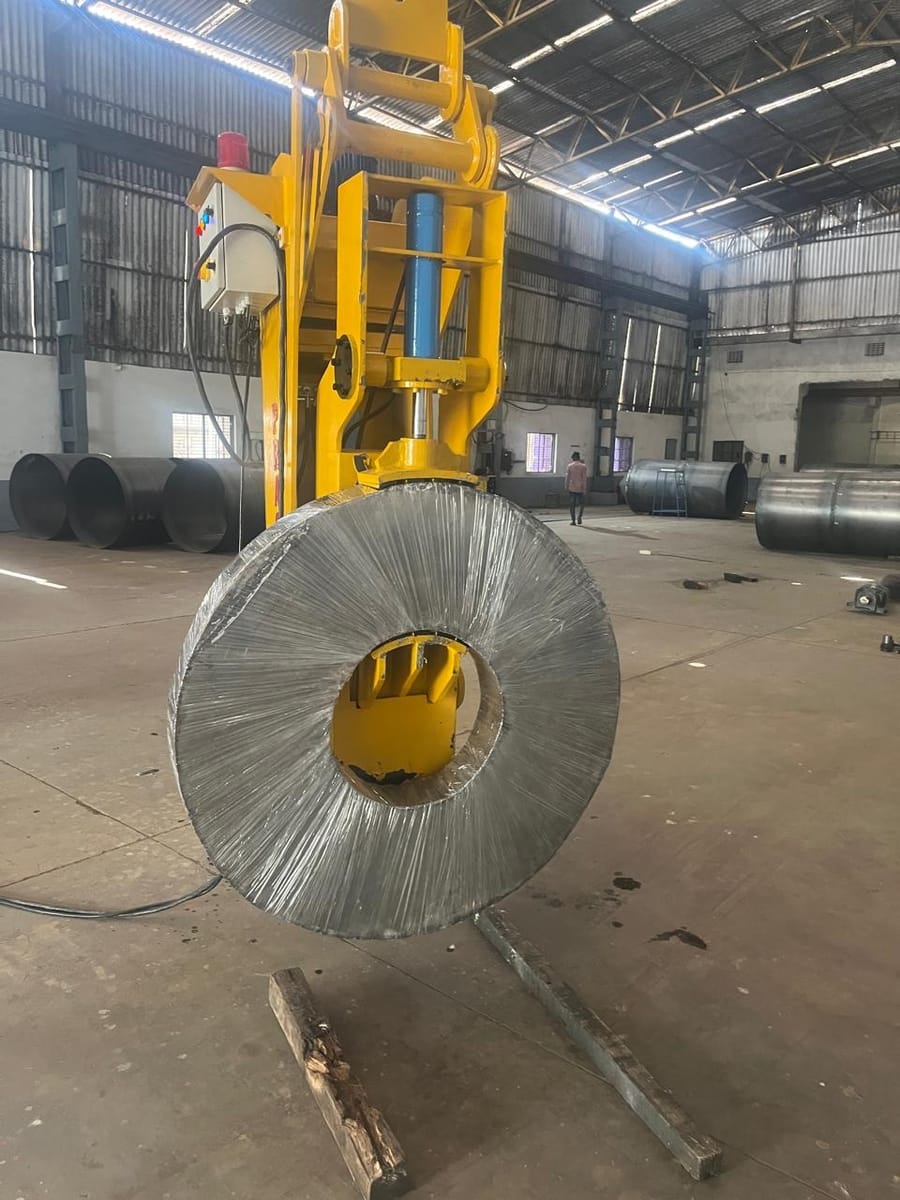
Specifications
- Capacity: up to 40 ton
- Rotation: +90° to −240°
- Speed: roughly 2 RPM
- Flip time: 90 seconds or less
- Control: remote handset or from the crane cabin
The wider-than-90° rotation range (down to −240°) is worth noting — it means the tilter isn't limited to a single vertical-to-horizontal flip, and can reposition a coil through a larger arc in one motion where the application calls for it.
Variants
- Hydraulic tilter — smooth, powered rotation
- Mechanical tilter — standard actuation, fewer hydraulic components to maintain
- Remote-controlled — wireless operation, so the operator isn't tied to a fixed control position near the crane
Where it fits vs. a floor-mounted tilter
An aerial tilter makes sense when floor space is genuinely constrained, when coils are already moving by crane between stations anyway, or when adding a ground-based tilter would mean rerouting an existing crane path. A floor-mounted coil tilter still has the edge in high-cycle, fixed-position applications — like directly ahead of a slitting line — where the coil is always tilted at the same spot and a permanent floor unit doesn't cost you anything in layout flexibility. The two aren't mutually exclusive: some lines use a floor-mounted tilter for the main process flow and an aerial unit for exceptions and out-of-sequence handling.
Interested in our industrial equipment?
Our engineering team, based in Indore, Madhya Pradesh, India, will recommend the right solution for your plant requirements.
Request a quote