Breaker rolls break oversized seeds or seed clusters into smaller particles using counter-rotating rolls with smooth, corrugated, or toothed surfaces, ahead of cracking or flaking. They handle a job the seed cracker isn't built for: seeds or clumped material too large or too fibrous to go straight to a standard cracker.
Where breaker rolls fit in the line
Not every feedstock arrives at a uniform, crackable size. Sunflower seed and cottonseed in particular can include larger clusters or oversized material that would jam or unevenly load a seed cracker's tighter roll gap. Breaker rolls handle this preliminary reduction first, so the cracker downstream receives a more consistent feed and doesn't take the wear hit from oversized material passing through it.
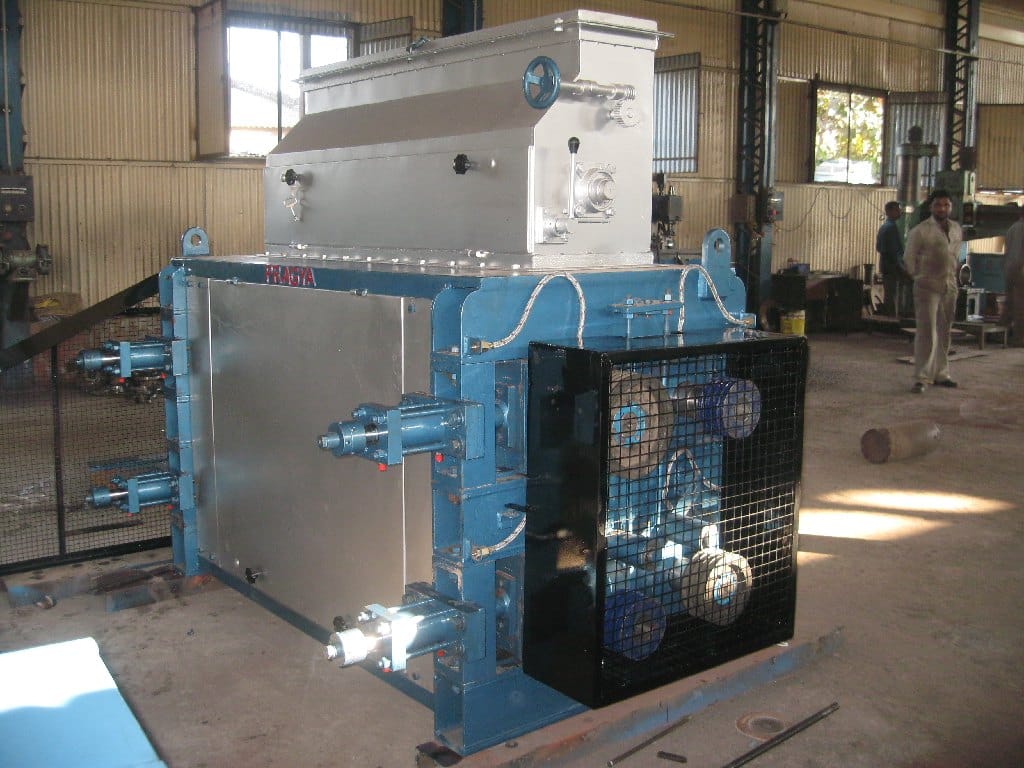
Surface options matter
Unlike the seed cracker, which uses a fixed corrugated roll design, breaker rolls come with a choice of surface types — smooth, corrugated, or toothed — because the right surface depends on what's being broken. Fibrous or clustered material often needs a toothed surface to grip and tear rather than just crush, while more uniform oversized seed can be handled with a corrugated surface similar to the cracker's own rolls. Gap adjustment on the rolls gives precise control over output particle size for whichever surface is fitted.
Specifications
- Roll configuration: counter-rotating with specialized surfaces
- Surface types: smooth, corrugated, or toothed
- Roll hardness: hardened surfaces
- Gap adjustment: precise control for different seed sizes
- Capacity range: 50-500 TPD
When you need this stage
If your feedstock is consistently sized coming into the plant, a seed cracker alone may be enough and breaker rolls become redundant capex. But for sunflower seed, cottonseed, or any feedstock prone to arriving in clusters or oversized batches, breaker rolls protect the cracker and flaker downstream from irregular loading, and hardened surfaces keep that protection reliable under continuous operation.
Specifying the right surface for your feedstock
The choice between smooth, corrugated, and toothed roll surfaces isn't cosmetic — each is suited to a different failure mode in the feed material. Smooth surfaces work well on material that just needs gentle size reduction without excessive fines. Corrugated surfaces bring more aggressive shearing action for tougher, more uniform oversized seed. Toothed surfaces are for genuinely fibrous or clustered material that would slip through smooth or corrugated rolls without being properly broken down. Getting this choice wrong shows up as either excessive fines generation or material passing through unbroken, so it's worth specifying surface type against an actual sample of your feedstock rather than a generic seed category, since batch-to-batch variation within the same crop can be significant depending on harvest conditions and storage.
Interested in our industrial equipment?
Our engineering team, based in Indore, Madhya Pradesh, India, will recommend the right solution for your plant requirements.
Request a quote