A pipe rotator uses motorized rollers to turn a pipe at a controlled speed, holding it in position while rotating it so a welder or inspector can work on a fixed point without moving around the pipe.
How it works
The pipe rests on a set of motorized, self-aligning rollers that grip it by friction and rotate it at a speed the operator sets. For welding, this means the weld joint can stay at a fixed, comfortable working position — often at the bottom or a set angle — while the pipe itself turns underneath the torch, rather than the welder moving around a stationary pipe. Height adjustment lets the rotator accommodate different pipe diameters, and on tilting models, the whole assembly angles up to ±45° to present the pipe at the optimal angle for a particular weld or inspection task.
Product variants
- Standard Rotator — motorized rollers for straightforward pipe rotation
- Tilting Rotator — adds ±45° tilting for optimal working angles
- Heavy-Duty Rotator — rated up to the full 100 ton capacity
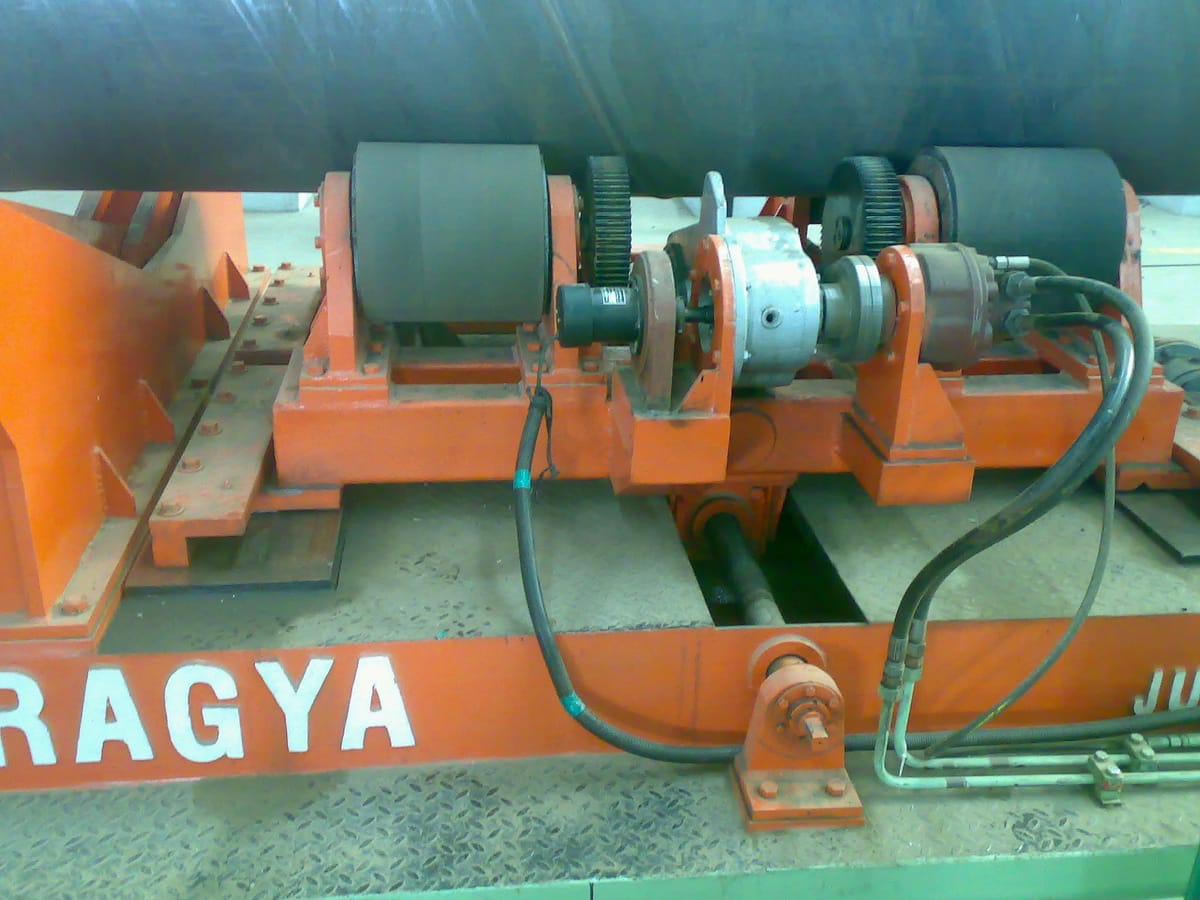
Specifications
- Load capacity: up to 100 ton
- Pipe diameter: 100-3000 mm
- Rotation speed: 0.2-30 RPM
- Tilting: up to ±45°
- Control: foot pedal, panel, or wireless
Key features and applications
Motorized self-aligning rollers, variable speed control for matching rotation to welding speed, tilting for optimal positioning, and height adjustment are the core features. These are used in pipe welding and fabrication, oil and gas pipeline construction, pressure vessel fabrication, and shipbuilding and marine work — anywhere a long cylindrical workpiece needs controlled, sustained rotation during processing.
Pipe rotator vs. pipe lifting tackle
A pipe rotator and pipe lifting tackle serve different stages of pipe handling and aren't substitutes for each other. Lifting tackle (slings and cradles) is what gets a pipe safely off the ground and onto the rotator or into position in the first place; the rotator then takes over once the pipe is set down, providing sustained controlled rotation during welding or inspection. In a typical pipe shop, a wire rope or roller cradle sling lifts the pipe onto the rotator's rollers, the rotator handles the turning through the work, and lifting tackle takes over again to move the finished pipe off. Specifying rotation speed correctly against your welding process (0.2-30 RPM covers a wide range) matters as much as capacity — a rotator sized right on tonnage but running too fast or too slow for the weld process won't help throughput.
Interested in our industrial equipment?
Our engineering team, based in Indore, Madhya Pradesh, India, will recommend the right solution for your plant requirements.
Request a quote