A plate leveler removes flatness defects and residual internal stress from steel plate or sheet by passing it through a series of offset rolls that repeatedly bend the material in alternating directions, working the metal back to flat.
How it works
The plate feeds through a stack of rolls arranged so the material bends slightly one way, then the other, in decreasing amplitude as it moves through the machine. This alternating bending exceeds the material's yield point at each roll just enough to relieve the internal stresses causing waviness, bowing, or coil set — the residual curvature steel retains after being wound or rolled. The roll gap is adjustable so the same machine can be tuned to different material thicknesses.
Product variants
- Standard Leveler — multi-roll design for general applications
- Heavy-Duty Leveler — for plates up to the full 152 mm thickness
- Precision Leveler — for thin sheets where tight flatness tolerance matters
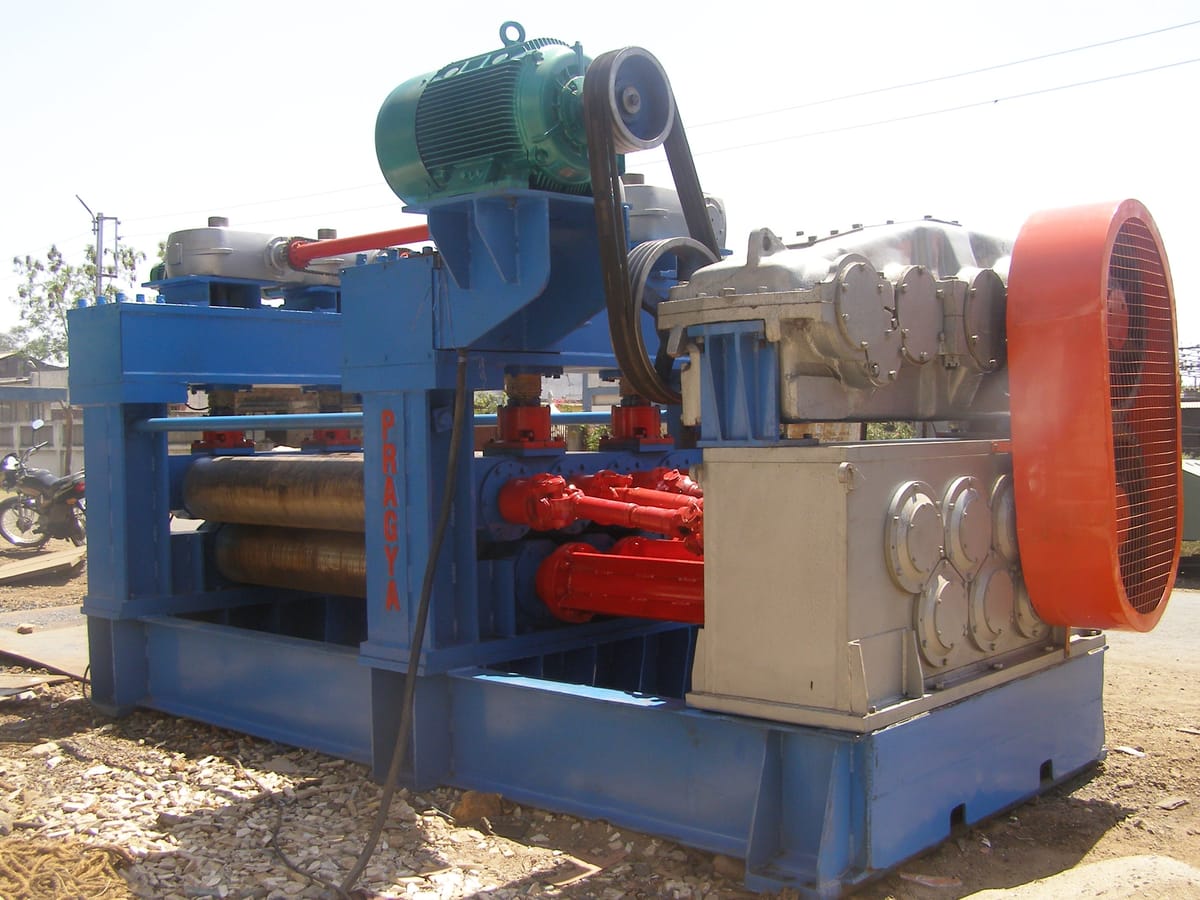
Specifications
- Thickness range: 0.13-152 mm
- Width: up to 3658 mm
- Rolls: 19-roll or custom configuration
- Leveling force: up to 7,600 ton
- Control: manual or PLC
Key features
Multi-roll construction gives precise flatness correction, the roll gap is adjustable across the thickness range, the process relieves residual stress rather than just visually flattening the surface, and the machine is built for integration into a production line rather than standalone batch use.
Applications
- Heavy machinery manufacturing
- Steel and metal fabrication
- Shipbuilding and offshore
- Pressure vessel manufacturing
Where leveling fits in the process
Coil set and flatness defects typically show up right after uncoiling, so a plate leveler is commonly positioned directly downstream of an uncoiler/recoiler in a processing line — flattening the material before it moves to cutting or forming stations. If the next operation is cutting to length, sequencing matters: feeding an unflattened plate into a hydraulic shear machine can produce inaccurate cut lengths or edge quality issues, since the material isn't lying true against the back gauge. Specifying a leveler comes down to matching its thickness and width range to your material and deciding whether manual roll-gap adjustment is sufficient or your production volume justifies PLC-controlled automatic adjustment between different jobs.
Interested in our industrial equipment?
Our engineering team, based in Indore, Madhya Pradesh, India, will recommend the right solution for your plant requirements.
Request a quote